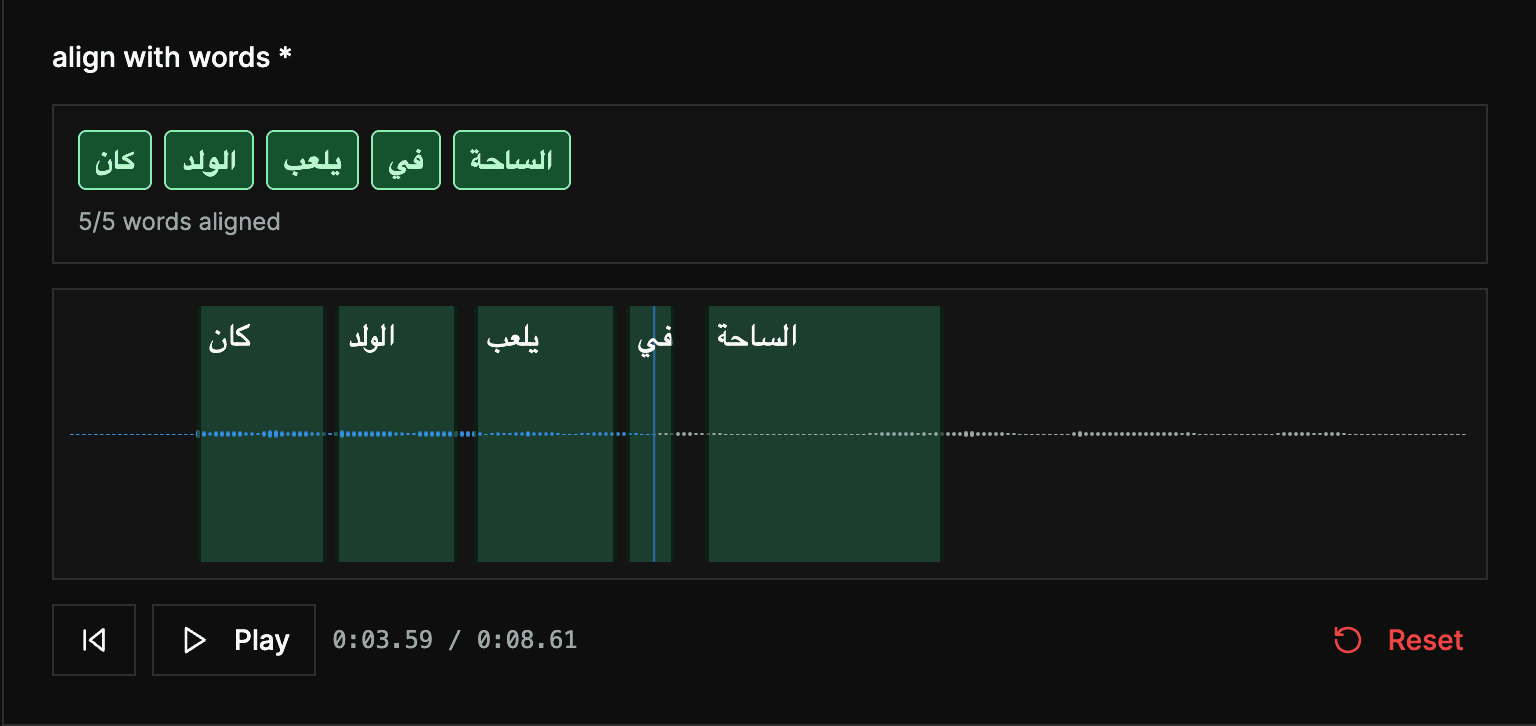
We're excited to release the newest addition to our Arabic data labeling platform: a self-serve, multi-user tool for aligning Arabic audio recordings with fully diacritized text.
At Nahw.ai, we help AI companies build high-quality Arabic datasets to train their speech and language models. We're now making our audio alignment tool available on the platform, so that anyone can start building accurate Arabic speech datasets on their own. Label for free with your team, or tap into our pre-vetted network of native Arabic annotators when you're ready to scale.
What is audio alignment?
Audio alignment maps recorded speech to its corresponding written text at a granular level, matching audio segments to words, syllables, and diacritical marks. For Arabic, this is especially challenging because diacritics (tashkeel) are critical for correct pronunciation but are often omitted in written text.
Our tool uses sequence alignment to evaluate diacritical accuracy: it first aligns the base characters between predicted and ground truth text, then compares diacritics only on matching character positions. This prevents a single missing letter from invalidating the entire comparison, giving you a far more reliable measure of transcription quality.
How does Nahw.ai compare to existing tools?
Easy to get started. No need to deploy your own server or negotiate an enterprise contract. Create an account and start labeling Arabic audio projects right away with no setup or onboarding.
Free team management. Invite collaborators to manage your labeling projects or annotate alongside you. Everyone works from the same dashboard with shared progress tracking.
Built for Arabic from day one. Most annotation tools treat Arabic as an afterthought. Our platform is designed natively for Arabic script, right-to-left text, and full tashkeel support, so you never have to fight the tooling to get accurate labels.
Alignment-aware evaluation. Our tashkeel accuracy metric uses sequence alignment rather than naive character-by-character comparison, so a single missing letter doesn't invalidate the entire diacritical evaluation.
High-quality native workforce. Offshore annotation doesn't cut it for Arabic speech tasks. We've built a vetted, on-demand workforce of native Arabic speakers with multi-tier quality control: Native QA, Domain Expert review, and rigorous validation, delivering low word error rates with zero hallucinations.
What can you build with it?
- ASR training data. Align audio with diacritized transcripts to train Arabic speech recognition models that actually get the vowels right.
- TTS evaluation. Measure how well your text-to-speech output matches the intended pronunciation, diacritic by diacritic.
- Dialect coverage. Collect and align speech samples across Arabic dialects, building datasets that go beyond Modern Standard Arabic.
- Model benchmarking. Use alignment-aware metrics to compare Arabic ASR models on a level playing field.
There's plenty of room for additional features and improvements, so we'd love your feedback to shape our roadmap.
Get started
Ready to build better Arabic speech datasets? Book a demo and we'll show you how our platform and annotation workforce can scale your next project.